
The London Fish Exchange
Data / Market Insight / News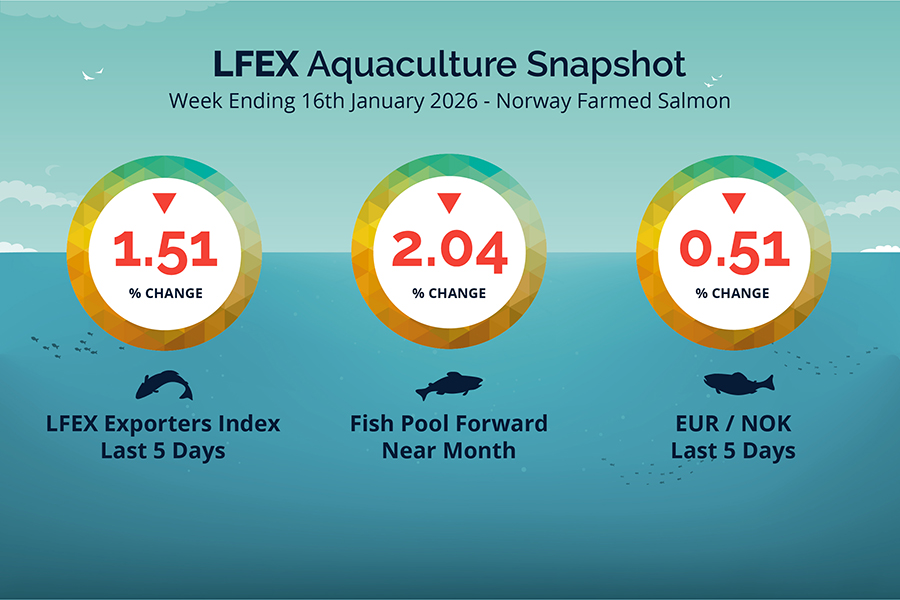
LFEX European Aquaculture Snapshot to 16th January, 2026

|
Published: 16th January 2026 This Article was Written by: John Ersser |
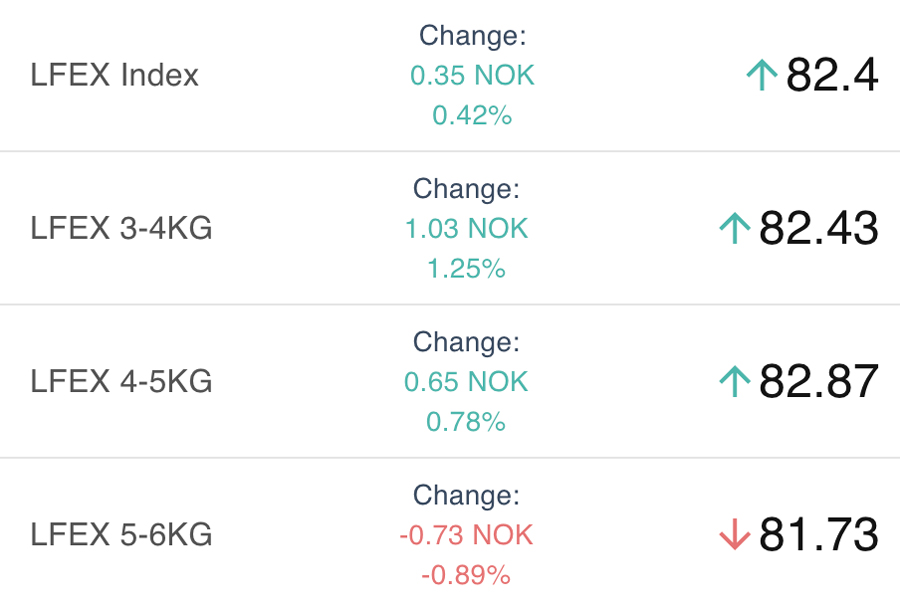
The LFEX Norwegian Exporters Index for Week 3 2026 ended the week DOWN -1.26 NOK / -1.51% to stand at 82.40 NOK (in EUR terms 7.03 / -0.07 / -1.0%) FCA Oslo Week ending Thursday to Thursday (yesterday).
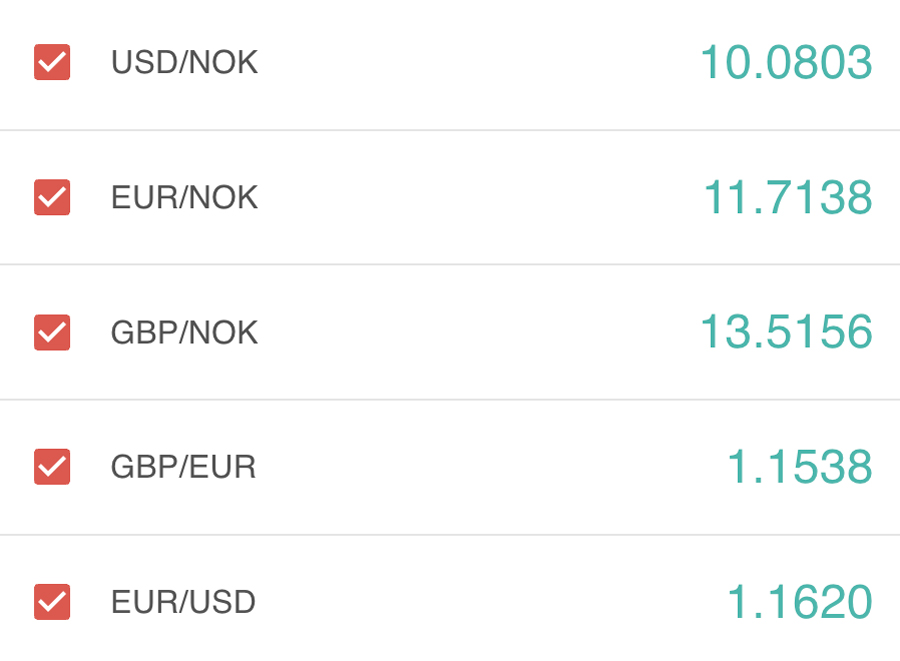
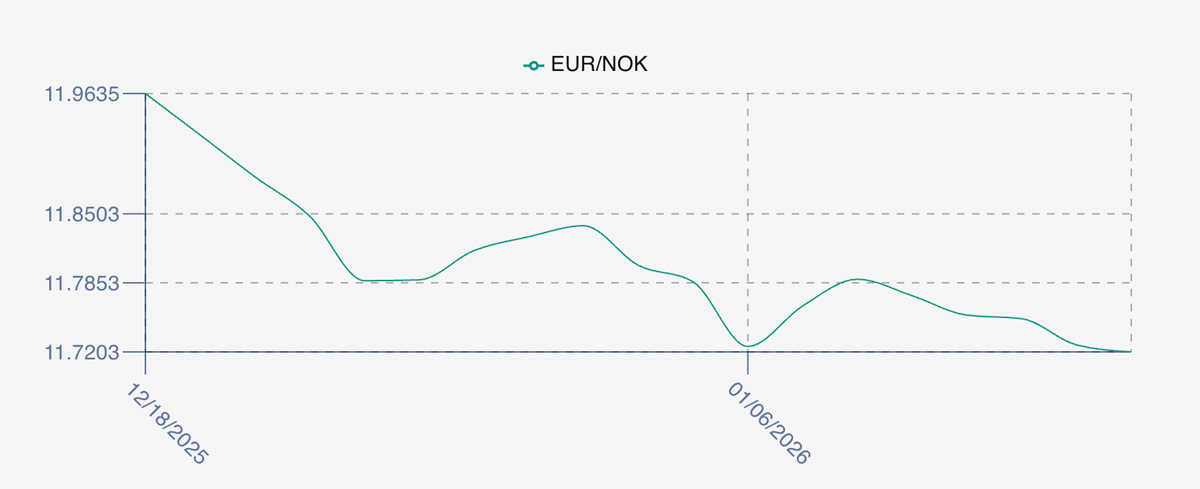
The NOK rate ended DOWN at 11.72 (-0.06 / -0.51%) to the Euro over the same period. The Fish Pool Euronext future February was reported DOWN at 8.15 EUR (-2.04% / 0.17) for the same period for comparison.
The Last Week
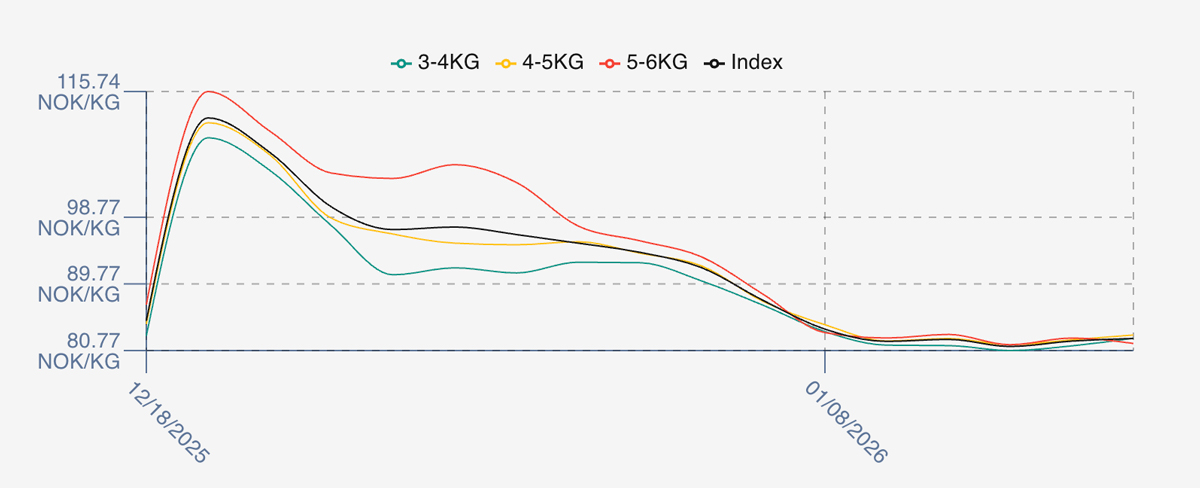
Stability in prices. Week 2 volumes record exactly 21,000 tons, some 31.5% / 5000t higher than the previous year and goes some way to explaining the drops we saw (along with a variety of other reasons detailed in last week’s report). This week we have seen a much calmer picture overall with index offered pricing hovering around the 82 level. Friday saw a small drop of 1.65NOK / -1.97% as prices continued week 2’s slide. Monday a minor pick-up (and the first up day since 19th December) although only to 82.28, and this was given back on Tuesday at 81.32 and the low of the week. Wednesday and Thursday saw small pick-ups to 82.05 and 82.4. Larger fish causing downward price pressure as 5/6s came-in lower than 3/4s and 4/5s on Thursday as the week closed out.
The FX rate softened this week, a fairly linear drop from 11.78 to 11.72.
Spreads have remained around 1.25 / 1.5 NOK through to Wednesday when we saw the pricing reversal as 5/6s fell below smaller fish. The spread being around 1 NOK with 5/6s at the low end of the range.
Next Week
Early indications showing prices around the 81.5 NOK level for the index as we head into the new week. That puts us down small (-1.00 NOK) from Week 2 close yesterday of 82.4. Prices are trending flat. There is good availability of fish, larger fish still applying pressure and demand is not pushing up prices.
Spreads are sitting around 0.5 NOK 3-6, with 4–6’s similar pricing.
The EUR NOK FX rate is this afternoon hovering around the 11.72 level which is flat from yesterday. This would give an indicative Euro index price around 6.95 EURO on offered levels Friday.
Volumes – Fresh Export
Volume figure for week 2 (2026) was 21,000 tons UP 5061 tons as compared to 15,939 in 2025 some 31.5 % HIGHER. Volumes for week 3 and week 4 (2025) 17,325 and 15,564 respectively for comparison.
Historical Price Guidance for Next Week
The LFEX Norwegian Exporters Index for Week 4 2025 ended the week down -0.89 NOK / -0.95% to stand at 92.77 NOK (in EUR terms 7.90 / -0.11 / -1.37%) FCA Oslo. The NOK rate ended up +0.05 NOK /+0.43% at 11.74. The Fish Pool Euronext future February was reported down at 9.10 EUR.
David Nye’s technical analysis report will be published on Monday.
Market Data (Click Each to Expand)
LFEX Prices
|
FX Rates
|
LFEX Indicative Exporter Prices (4 Week)
|
EUR / NOK FX Rate (4 Week)
|
|
Prices Ending 16th January, 2026 For Friday's Price For Next Week, Offers & Trading Please Register |
Did You Know?
You can let different people from your company use the platform and share information?
The system is set-up to be able to show all your offers or trades going through the system and allow multiple users in your company access to this information in real-time. This helps build a picture of sales / purchases and pricing across the business and facilitates teams work and optimisation of the selling / buying process, as well as giving logistics and finance real-time information. This data is private and only available to your organisation.
FAQ’s
Q. How do electronic markets work?
A. Electronic platforms perform many roles for markets and market participants.
By bringing a community together you get a much better view of available inventory (liquidity), access to more participants, more opportunity for price discovery, ability to track market pricing electronically in real-time, pre-trade checking and secure and robust confirmations between parties. They throw off mountains of data that can be used to analyse pricing, trading patterns, counterparty performance etc.
Further, they can provide a single point of connectivity for settlement and documentation and an independent and verified record of truth. They provide huge efficiencies in process, less errors, automation of orders / trading / settlement processes. They give participants the ability to access the right price for any given market condition, and free up staff time to focus on optimising business and relationships especially in times of stress.
